


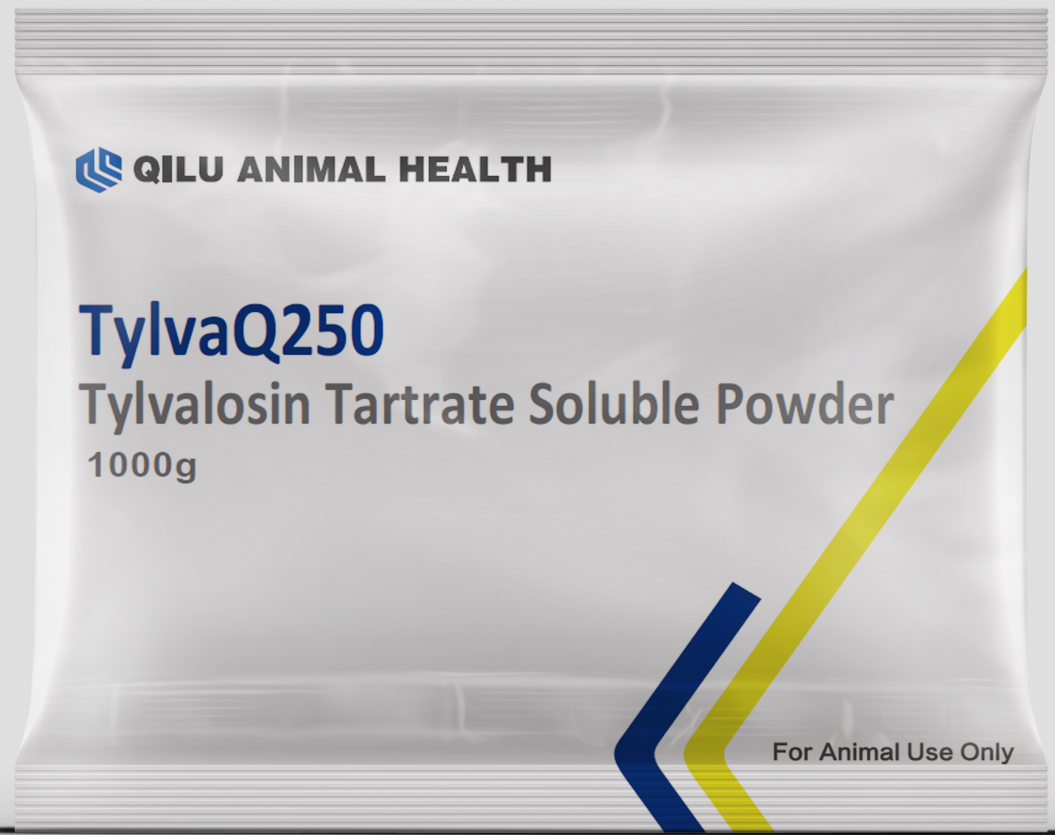
TylvaQ250
Category:
Keywords:
TylvaQ250
Details description
Composition, content of active substances in formulation of the products
Each g contains:
Tylvalosin (as tylvalosin tartrate) 250mg
Pharmacological characteristic of the products including
Pharmacodynamics
Macrolide antibiotics. Tylvalosin tartrate can inhibit the synthesis of bacterial proteins, thereby inhibiting bacterial reproduction. Tylvalosin tartrate has antibacterial activity against Gram-positive bacteria, some Gram-negative bacteria, and Mycoplasmas. Its antibacterial spectrum includes Mycoplasma gallisepticum, Mycoplasma synoviae, Mycoplasma meleagridis, Mycoplasma hyopneumoniae, Mycoplasma hyosynoviae, Mycoplasma hyorhinis, Haemophilus parasuis, Pasteurella multocida, Streptococcus spp., Treponema hyodysenteriae, Treponema suis, Lawsonia intracellularis, Clostridium perfringens, Ornithobacterium rhinotracheale, and Staphylococcus spp. It is also effective against Gram-positive bacteria that are resistant to other antibiotics and has strong antibacterial activity against Mycoplasma gallisepticum and Mycoplasma synoviae. Bacteria are not prone to developing resistance to tylvalosin.
Pharmacokinetics
Tylvalosin tartrate is rapidly absorbed by oral administration. The highest plasma concentration was reached within 30 minutes in chickens and 2 hours in pigs. Tylvalosin tartrate and its metabolite 3-O-acetyltylosin are systemically distributed, with tissue drug concentrations higher than plasma concentrations, and tissues with the highest drug concentrations being respiratory tissues, intestinal mucosa, bile, spleen, kidney, and liver. Tylvalosin tartrate enters the intestinal tract via the bile and is mainly excreted in the faeces and urine as 3-O-acetyltylosin. Unchanged drug and 3-O-acetyltylosin were rapidly degraded and disappeared in feces.
Indication
For treatment of chicken respiratory diseases caused by Mycoplasma, and swine respiratory diseases caused by Mycoplasma, Haemophilus parasuis, Pasteurella multocida, and Streptococcus suis, as well as infections caused by swine dysentery spirochetes and other sensitive bacteria.
Dosage and Administration
Calculated on tylvalosin. Mix in drinking water: 50-85 mg per liter of water for swine, continuous for 5 days; 200 mg per liter of water for broilers, laying hens and breeders, continuous for 3-5 days.
Contraindication
Do not use in cases of hypersensitivity to tylvalosin or to any of the excipients.
Warnings when using
Do not mix with other veterinary drugs without compatibility study.
Warnings for drug users to prevent and treat animal diseases
People with known hypersensitivity to tylvalosin should avoid contact with this product.
Avoid direct contact with skin and eyes.
Not for human use.
Keep out of reach of children.
Withdrawal time
Swine: 3 days.
Chickens: 5 days; the egg discard period is 0 day.
Information about using the product
Use of the veterinary medicinal product deviating from the instructions in the SPC may increase the risk of development and selection of resistant bacteria and decrease the effectiveness of treatment with other macrolides due to the potential for cross-resistance.
Storage
Store in an airtight container, in a cool and dry place.
Shelf life
24 months after the date of manufacture.
How supplied
Bags of 1kg, 5kg, and 10kg.
Related products

Product Inquiry
Qilu Animal Health
No. 10688, Wenliang Road, Dongjia Town, Licheng District, Jinan, Shandong, China

Message Us